Tuesday, 15 January 2013

A Recital with Pianist Joanna Macgregor and a Bat.


The recital by pianist Joanna Macgregor on Sunday afternoon in the concert hall at Marlborough College, should have included music from "Die Fledermaus,"  (German for bat) for, during the interval a bat joined us in the auditorium, and much to our amusement, swooped happily over our heads.  He/she timed his/her flight well, because,  as Joanna reappeared for the second half, the bat flew into the curtains, and remained there to enjoy the   "Three Intermezzi" by Brahms and Beethoven's "Waldstein" sonata in C major.   I hope his little ears were well tuned in!    It is so good to hear live music, and during the first half we'd  listened to Bela Bartok's the "Out of Doors Suite," an atmospheric piece of music, using folk themes, and with great contrasts between the loud and soft passages.    The music is not quite my "cup of tea" and I would not listen to it on a CD, but seeing and hearing the interpretation live, added an exciting edge to the work.   

The recital was one of the College's series of autumn and winter concerts.   I went with a friend who had managed to acquire two tickets from another friend who, unfortunately could attend. I must really open my mind to modern music, and not stay so faithful to my dearly beloved JS Bach and everything that has been composed before 1850!    I once saw Benjamin Britten's opera "The Taming of the Screw," and was bowled over by it, but its not music I would listen to by choice.  Perhaps I will tackle some Stockhausen this year!


The "Steinway" concert grand piano, played by Joanna Macgregor.
This  photo was taken on my  mobile phone and is somewhat fuzzy, because last week at coffee morning in the "Black Swan" I spilt my coffee all over the phone.  I dried it out with tissues, but forgot to clean the camera lens, and I now have several photos that look as if they were taken on a foggy evening.


A bat appears somewhere in this photo, I'm not sure where, but he/she is somewhere to be seen!    Stage lighting hangs from the ceiling, and the curtains are closed, so maybe the bat thought it was dusk, and ventured out for a display of aeriel acrobatics!  No one screamed during the taking of this photograph.

Sunday, 13 January 2013

Singing again in Marlborough College Choir.


"Here we are again, as happy as can be, all good singers, and jolly good company!"  Rehearsals started last Friday for our annual Easter concert at Marlborough College.  This year we are singing "Ein Deutsches Requiem" by Brahms, and singing in German, much to the consternation of all,  except me of course, and the few other Germanophiles!   
Above Simon our conductor looks through the music.  His wife has just given birth to a second son called Samuel, and we caught up with all the news from the past ten months, as the choir last met in March 2012.  We were also introduced to our new accompanist, a young piano graduate from the Royal College of Music.  She plays the Steinway grand piano left.

The Requiem is a sad but romantic piece of music, written after the death in 1856 of Brahms´s friend Robert Schumann, and nine year later in 1865, that of his mother.   We cannot be exactly sure what prompted the writing of this great piece of music, but Brahms was deeply affected by the death of both these people.  The second work in our concert is Dvorak's "Te Deum" sung with great gusto in Latin. The score looks very black in places with  many crotchets and semiquavers, a sure sign that the orchestra will be very busy and noisy, particularly in the brass and timpani sections!


Simon sorts his music during the interval, while the sopranos in the foreground, and the altos, background, relax and chat among themselves.  Over half the choir have sung the Requiem before, so that makes learning it so much easier.  With good singers leading the way, the rest of us will be carried along!   I have a CD of the work, and will listen to it over and over again, and follow the notes in my score.  The entire Requiem lasts 90 minutes, and Te Deum, a much  shorter work, will be easy to learn.


Here is the whole choir, with the tenors and basses, (never many in any choir) sitting in the back rows, to the right in the photo.   The concert hall is being renovated this year, and is not well lit, especially for those singers in the back rows.  I sit about centre of this photo, and have plenty of light to read my score with ease.  We have only 10 rehearsals, and our concert takes place at the end of March.

Saturday, 12 January 2013

Frome Town Trail in Bright Sunshine


We returned to Frome on Friday morning, to follow the town trail, and listen to the history of this lovely little town in Somerset, just over the border from Wiltshire.  Thirteen of us took the bus, firstly the No. 49 doubledecker to Trowbridge, where most walkers went upstairs, although two of us stayed downstairs.  Riding on the top deck of a doubledecker makes me feel very quiesy!  At Trowbridge we changed for the Frome bus, and arrived in a town bathed in sunshine.   

We enjoyed a guided tour, with much walking up and down steps, narrow streets and damp little alleyways.  The town has a rich variety of buildings of historical interest,  and connections with the wool trade, weaving and the foundery industry.  At one time the town was larger than Bath, and vied with the city as being a very desirable place in which to live and work.


This Valentine's Day lamp post is a special street light for lovers, that is lit on Valentine's Day each year.  The red postbox has GR embossed upon it, and dates from the 19th century.  It must be cosy to sit here on a winter's evening, well wrapped up in hat and gloves, holding the hand of your true love!  


This old cobbold street contains many interesting little shops, all full of unusual goodies.  Several of us have decided to return again soon with plenty of money,  for a day's shopping trip.  The street is traffic free, and with the many little cafes for tea, coffee and cake, it will make a lovely day out.  Spring must arrive first, with the sun shining in a blue sky.   We don't do rain!


When the wool trade declined, Frome began to embrace new engineering industries.  From 1685 Cockeys cast church bells, and later  began the production of cast iron components for the gas industry, and in 1832 Frome was lit with gas lights.   The old old steam hammer above is a monument to "John Webb Singer and Sons'"  whose castings factory stood in Eagle Lane.  In 1848 John Singer, then 30 years old, was a clockmaker, and established the factory, which later started casting munitions and statues.  The Statue of Justice above the Old Bailey was cast in Frome, as was the statue of Boadicea on London's Embankment, and the statue of King Arthur in Winchester town centre.   A  housing estate now stands on the former site.


We enjoyed lunch in the "Old Bath Arms" a Georgian building  with fine beaded windows.  We drank beer, pear cider in my case, tea and coffee, and enjoyed the atmosphere of this fine room with its open fire.   The landlord is South African, and cooks a tasty variety of homemade burgers.  I savoured the chicken and salad version, and excellent it was too.   We tumbled out, and caught  the bus at 1.40pm  and were back in Devizes at 3pm.  What an interesting  day in bright sunshine.


Thursday, 10 January 2013

Sunrise with thoughts of Blog Entries and Wolfi Mozart!


I began Tuesday with this view from my bedroom window.  I can open my blinds, and on my pillow, rest my head on my hands, and watch the sun arise in all her glory.  What a sight it was that morning, with the sun reappearing after so many days of greyness.   The day was to be busy, because, among other things, I had to chose and print off a blog entry for our afternoon writing group.  I spend many hours writing, and if I´m not careful, I will develop square eyes through staring at a computer monitor for too long.    

Just before Chirstmas I tried to leave the "Creative Writing Group."  Hands were  raised in horror by the other members, and  they said, "No!"   So a truce was arranged, and now I will present a blog entry with historical interest at our meetings.   I find it easy to write newsy blog entries, and with the help of photographs, I can write an interesting article at the drop of a hat.  That´s not the case when writing of a short story!  That demands much thought, blood, sweat and tears, and I don´t have enough time to write short stories, particulary when I´m concentrating on writing as much German as I can.


The Devizes Chamber Choir met on Tuesday evening for the first time this year , when we practised Mozart´s "Te Deum."  This short, exciting piece of music, lasting about seven minutes in toto, was written when Wolfgang was 13 years old!   I was still reading girly stories about horses at that age, but this young man, although dominated by his father, was writing these masterpieces at a tender age.   

We are singing in latin of course, and much discussion ensues about the correct pronunciation of the words, particulary the "ch."    Fortunately we have a latin expert singing with us, so all will be well.   The score is printed and written in German, so no problems with the universal language of musical notation,  but I have learnt a few new words from the text.  Every little new word goes into my long term memory, it´s the getting it to stay there that is another matter!

Monday, 7 January 2013

A Devizes Circular Walk, via a White Cat, the Castle and St John´s Churchyard.

I've walked past black cats before on my rambles, and know that they are supposed to bring good luck,  but what does the passing of a  white cat herald for the New Year!  Ideas post haste to Vicki please!   On Sunday I did my first walk with my new "Sunday Walks" group, all two of us that day.   Several friends want to join, but most had commitments, but promise to come along next Sunday.   I like walking, and it is made easier when accompanied by other walkers.  Puss was friendly, in fact she following me down the path to the churchyard steps, which are steep to climb, and  she obviously didn't want to expend energy and follow me, so we parted company.


I passed Devizes castle, a Victorian folly, which is built on the foundations of the former 11th century Norman stronghold.   The castle has a turbulent history, having been fought over, burnt down, used as a prison for Princess Matilda, used by the Royalist  to defend Devizes during the Civil War in the mid 17th century, when the Parliamentarians were bombarding the town with canonballs from the top of Jump Hill.   Queen Isabella, the wife of King John gave birth to a son here, and the crown jewels were  hidden here for safe keeping against a French invasion.

The castle is now the private home of an American family.   Back in the 1930s the people of Devizes held the town pageant here, and must have had a lot of fun dressing up in medieval garb, and fighting one another with wooden swords.   I expect  the lady's dresses and headgear were splendid, and it must have been great fun flirting with the medieval knights on their make believe horses.


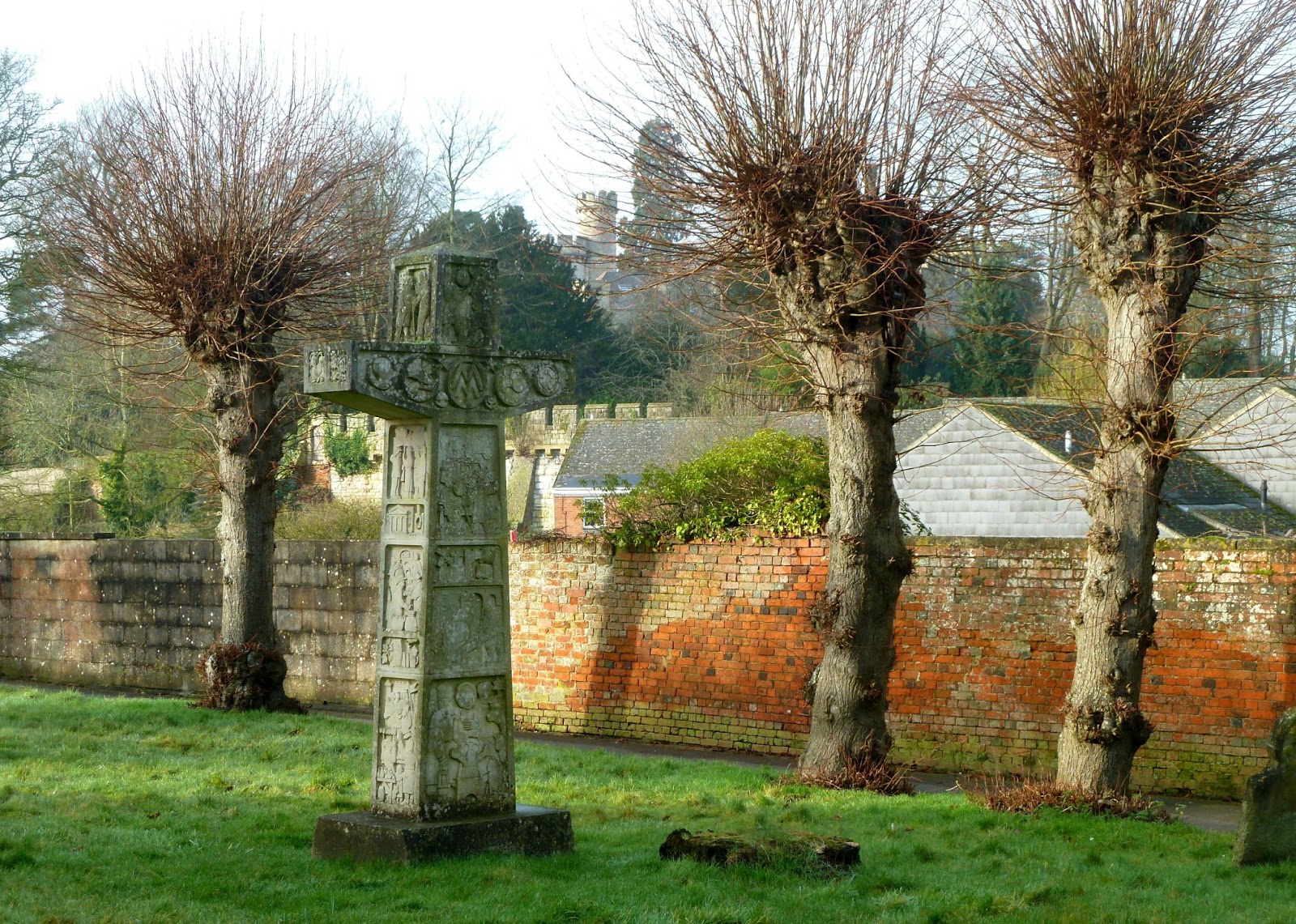
 The Millenium Cross in St John's churchyard was erected to celebrate the year 2000.  The photo shows the cross,  against a background of pollarded trees and the crenellated castle tower in the background.


The obelisk seen to the left of the photo, marks the burial place of five coach passengers, who were drowned in Drew's Pond in the 19th century, when their coach left the track and overturned into the water, drowning all onboard.  There are many interesting 17th cent tombstones in the churchyard.

Saturday, 5 January 2013

Semington to Trowbridge via the K & A Canal.

We took a walk along the towpath this morning from Semington to Trowbridge.  It was a pleasant walk, flat of course, and with few puddles and mud pits, because we deliberately stayed on towpath, track and paths.  The weather has taken a turn for the better, with NO rain, although the skies are still grey and overcast.    A record amount of rain has fallen on Great Britain this year, and the ground is completely waterlogged, with water overflowing the bore holes, becuase it has nowhere to drain away.   The canal level is raised, and the overspill weirs are working "nineteen to the dozen."

The boats along this stretch of the canal are moored against private land, and not beside the towpath.  The canal is managed by the recently formed "Canal and River Trust," which took over from "British Waterways" last year.  Boats moored towpath side are subject to  regulations that govern the time they can stay in one place.   Those moored against private land pay the landowner a mooring fee, a portion of which is paid to the C & R Trust, as the trust owns the water and the first metre of canalside.


Above can be seen narrowboats of various sizes.  Some are used for holidays, some for people who live onboard all year round.  The cost of mooring is based on the length of the boat, the smaller the boat, the cheaper the fee.  Boats need a yearly licence to use the water, plus boat insurance and a boat safety certificate.  It is recommended that boats carry carbon monoxide alarms, as when sleeping aboard, beds tend to be below air vent level, and several boaters die each year for poisoning caused by the fumes from wood burning stoves  which are not properly ventilated.  The gas is odourless, and difficult to detect without an alarm.


We walked past this imposing building, the main entrance of the old "Semington workhouse."  Built in 1838, to designs by HE Kendall,  the Melksham Union workhouse was built in the "Poor Law Commissioner's" standard cruciform plan.  It housed the poor and destitute, and included people of all ages, from children to the very elderly.   The inmates were separated, and lived in the different parts of the buiilding, with their own workplaces and exercise areas.  Even married couples were separated, but allowed to meet on Sunday.   Life must have been very difficult!

Tuesday, 1 January 2013

New Year's Day 5 Mile Walk Around the Devizes "Bounds" (The East Route to Avoid the Mud.)


Just a short write up this evening as, after a 5 mile walk with soggy conditions underfoot, I feel quite weary tonight.   I'm tempted to watch the traditional New Year's Concert from Vienna showing now on the tv, but I cannot sit still for too long, otherwise I will drop off to sleep again!   Twelve of us turned out today for our walk, which took us around the easterly route of the Devizes "Bounds" the medieval boundary of the town of Devizes.   It's a mostly flat walk, although the uphill section is on pavement, which is not my favourite surface on which to walk.  But it was not muddy!   We usually take the westerly route, but that involves a long downhill slope into a farmyard,  that is muddy, even in drought conditions.   Quite how deep the mud is at the moment after weeks of torrential rain,  I cannot imagine.    

Above we can be seen standing in front of the imposing former entrance of the Devizes Asylum.  The hospital was closed many years ago, and is now converted into flats and smart town houses.   J researched the history of the hospital,  and she can be seen in her red hat, reading her prepared tract.


We walked into "Drew's Pond," a nature reserve, which was once a medieval burial ground, and later used for the burial of the patients and staff who had died in the asylum.  Every year a short memorial service is held by a local priest, as an act of remembrance for the many poor pauper souls who now lie in unmarked graves.  Some tombstones remain, although it is impossible after all these years to read the inscriptions thereon.  J once again had done her homework, and gave us a brief history of the area.   We walked back into Devizes, where some  walkers went for lunch in the "Silk Mercer," and I came straight home for a cuppa and a snooze!