Saturday, 2 November 2013

Printing Christmas Cards

The assembled ingredients for the printing of cards.

A creative urge came upon me this week, after rediscovering the delights of making your own stamps, and printing instant Christmas cards.   I've spent my life as a potter cum painter, printer, needlewoman, jewellery maker, collage card maker and doll's house potter, and over the last few years have taken a step back from the creative world.  

However times are changing, so I've gathered together most of the necessary bits and pieces for printing, and hope to make a start this week.  I've ordered some sharp lino cutters, as these can be used to cut a design into the blocks of rubber I'm using for printing.  I've cut two little flowerpot shapes, and have tried out the design using the black stamp pad you can see to the left of the photo.  I bought a packet of card blanks, and also some handmade,  decorative Indian papers, with interesting leaves and flowers mixed into the surface.  These I can use as a background for my designs.    

The red, soft pencil draws the design onto the rubber blocks, and the yellow handled cutter is useful for cutting the initial larger shapes.  I now need the fine cutters for the leaves and flowers.  As soon as I produce my first card, I will display it for all to see. Fingers crossed!


Sunday, 27 October 2013

The American Museum in Bath

There was so much to see, much too much for a single visit, so we have decided to return again in 2014 for another look!  The museum covers three floors, and starting in the basement, you have a chance to read all the facts, figures and dates of  the most significant happenings that shaped modern America.  We were totally bemused with so much information, although a guide told us, that the museum had recently simplified all the details!   History must always start from around the year "dot," but in one visit, there was just too much to take in!

I was happy to move into the room settings on the second floor, each displaying furniture and artifacts from a particular period in time.   On the right is the American/ Dutch room, which is really an American/Deutsch room, the word Deutsch having been corrupted.  German settlers arrived in America in the 18th century, and bought their culture and artifacts with them.   What a journey these early immigrants must have had, travelling over land and hostile sea, in search of a  new life. Migration is as old as humanity itself,  people will always seek a better life for themselves and their families.

 The original interior of a 17th century Massachusetts house, which was shipped to Britain, and reconstructed in the Museum.


The American Museum in Bath was opened to the public in 1961, the achievement of four colleagues, a transatlantic alliance between two American collectors, a British born antiques dealer and a local furniture restorer from nearby Freshford Manor.  A friend of the group became the first Director of the Museum.   The group had considered establishing a museum early in 1956, after visiting several historic houses and "living history" museums in the US.

Collecting began in earnest in 1958, with each piece intended for display,  testifying to the artistry of all Americans, and how the people had lived in the past.  Panelling and floors were also shipped over to Britain, enabling period rooms from demolished buildings in American to be reconstructed within the spacious interiors of "Claverton Manor."   Many decades on, The American Museum in Britain remains the only museum outside the US to showcase the decorative arts of America.

 The mind boggling history of the events leading to American independance, and the civil war that eventually united the country.

 A lesson on how to be "quick on the draw."

Little girl´s bedroom, complete with a doll´s bed at the foot of her bed.

This room contained painted wooden furniture, a style of decoration that became so popular here a few years ago.  The quilt is hand stitched, as are the many on display in the Quilt Room in the museum.   You could spend a morning alone looking at the amazing designs and stitch work that produced these bed covers.

The museum cafe is housed in the former "Orangery," where we enjoyed a good cup of English tea and pieces of cake.   A good time was had by all three of us!

Tuesday, 22 October 2013

Sheep, more Sheep and Rabbits in 15th Century Wiltshire.

I became a member of the Wiltshire Archaeological and Natural History Society for the second time last week. I had been a member way back in 2002, but was then a working woman, and did not have enough time to pursue my interests in history and archaeology.   Now, as a lady of leisure,  I have all the time in the world!  The leaflet left, gives information about many of the artifacts in the newly opened museum galleries, some of which will be lent to the new museum and visitor centre being built at Stonehenge, just 15 miles from Devizes, which opens on December  18th.   

The old visitor centre has been a national disgrace for the last decade, and the new one will have all the facilities of a modern centre, with museum, cafe, shop, and all that's necessary for a memorable visit.  Visitors arrive at the centre, where they climb aboard small vehicles, which take them the short distance to the world famous stones.

Devizes Museum hosts a number of Saturday talks throughout the year,  given by eminent historians, who give an illustrated talk about their particular interest.  Last Saturday's talk was about land use in 15th century Wiltshire, and the division of the landscape into what was suitable for sheep grazing and agricultural farming.  Thousands of sheep roamed the hills, with the rich earth of the valley areas set aside for crops, oats and barley, potatoes and other vegetables.  A good source of protein was produced by rabbits, and throughout Wiltshire, "Warreners" managed the rabbit population as best they could,  in huge rabbit warrens.  

Our speaker's name was Dr David Hare (rabbit!) and he talked at length about the problems of accessing animal numbers during the 15th century, when so few records remain.  There are, however, some important farm documents still in existence, which can be used to assess possible numbers of sheep and  rabbits.   In one such document, a warrener tried to count his rabbits, which is no easy feat, but he came up with an approximate number.  He suggested that he had more at one time, but that some of the rabbits had walked away!   Rabbits tend to do that sort of thing, just wander off into the landscape!

Inside the museum leaflet, with photos of various artifacts.

The museum was founded in 1853, and shows an interesting collection of artifacts from the Neolithic, Bronze and Iron Age, Roman, Saxon and Medieval periods.  New galleries have recently opened, displaying roman gold ware,  some of which has never been displayed to the public before.


Friday, 18 October 2013

Walking at Alton Barnes White Horse with a Friend and a Dog.

 Maxi heads towards the white horse.

Wiltshire is famous for its White Horses carved through the grassland into the white chalk.  This one at Alton Barnes faces to the left, looking towards the "Millenium White Horse" carved in the downs above Devizes, which faces, unusually, to the right.  The originator was a Mr Robert Pile, of Manor Farm, Alton Barnes, who, in 1812, paid twenty pounds to Mr John Thorne, a journeyman painter, to design the white horse, which he sub-contracted for excavation to a Mr John Harvey of Stanton St Bernard.    

Before the work was finished however, Thorne disappeared with the money, and Mr Pile was left to pay out again.   Thorne was eventually hanged in Portsmouth dockyard in 1776,  although for an act of arson carried out there, and not for theft.

The horse is well looked after, with scouring at regular intervals.  In 2010 it underwent major renovation overseen by the landowner Tim Carson and Alton Barnes Parish Council.   A helicopter delivered 150 tons of fresh chalk by air,  and volunteers replenished the surface of the figure.  There is a tradition of lighting the white horses to mark special occasions, and in recent times this horse was lit by candlelight  at the winter solstices in 2001 and 2002, and then every year from 2004 until 2011.  It was also lit on June 30th 2012, to mark its 200th birthday.


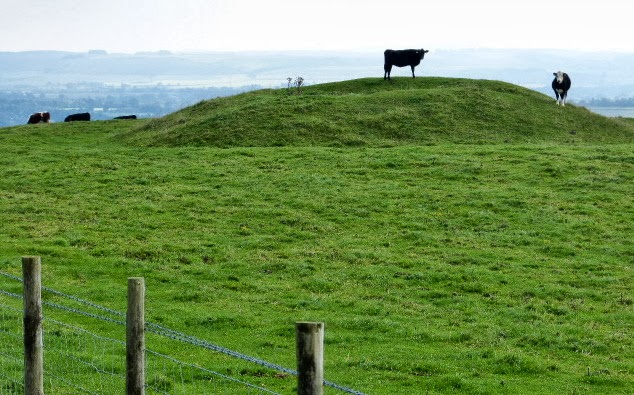
 The cows stand guard on top of a bell barrow.

Over the hills and far away at Alton Barnes in Wiltshire.

Tuesday, 15 October 2013

French Organ Music in Salisbury Cathedral

Our cultural night out began on the top floor of Scoby's Fish and Chip Restaurant in Salisbury's Market Square, and a very good place it was to start an evening!  We climbed the stairs to the second floor, where I tackled a plate of cod roe and chips, with P enjoying chips with one fish cake. We both enjoyed a good cup of tea, and around 6.45pm set off for the organ recital in the cathedral.

The evening was fresh and very windy, with the strong wind blowing from the north, and blasting the leaves off the trees.  The huge space of the cathedral nave seemed warm by comparison, and we found seats at the front of the nave.

Mr John Challenger, the Assistant Director of Music at the cathedral, gave a performance of French music written in the early 20th century.  I was not familiar with any of the works, but was pleased to have a chance to stretch my musical mind, and open it up to more contemporary music.  I'm a bit hooked on JS Bach I'm afraid, and most of the time I close my ears to anything composed much later than 1850!   How narrow minded can I be?

The well lit cathedral at 7pm on a cold and windy night in October.

The nave, with our seats to the front left, three rows back.

We had a slight problem during the performance, with what sounded like someone's hearing- aid buzzing!  At first we thought an organ stop had become stuck, but think that the little old lady behind us had fallen asleep and her hearing-aid was making a horrible noise.  Everyone wondering where the noise was coming from, and we did wonder how anyone could sleep through a recital of loud organ music in a cathedral.  There's a first time for everything!

The cathedral the following morning, with bright sunshine but with the wind still blowing.

This photo was not easy to take, as I had to press the button just as the leaves hid the sun from the lens.   It's not too bad an effort on my "pocket camera" with the sun in my eyes.


Sunday, 13 October 2013

Same Scene, Different Edits.

The Marlborough Downs above Pewsey with an artistic edit.

I have a new Lumix camera to play with, and I'm spending time twiddling the various buttons, and attempting to work out how best to use the apparatus!   I'm please so far, although the camera is heavy to carry, and not as easy to use as my old "snap happy, pocket camera." Some edits are best used with certain subjects, as in the one above, where the edit has enhanced the dramatic sky.   

 The same scene, but with a high key edit.

A different edit, and different feel to the atmosphere.  I think I will like using the camera, once I know what I'm doing!

The scene again, but with a one colour edit.

I like this edit, and can think of many  scenes on which it will be appropiate.  I'm glad the camera is, to a certain extent idiot proof.  It means select the right buttons, and you cannot go wrong!   Time will tell.

Thursday, 10 October 2013

Investigating the Stone Quarries in Westwood with the Geology Group.

We braved the steep hills above Avoncliff near Bath, to view the rocky outcrops of limestone, the best of which was used to build the wonderful buildings of Bath and many bridges along the Kennet & Avon Canal.  The photos left shows us studying the limestone beds and searching for fossil shells in the fallen stone at Westwood quarry.   

I was lucky enough to find a perfect little shell, but as it was attached to a 1kg piece of rock, and was too heavy to carry home.   The quarries were intensively mined in the 18th and 19th century, and despite not being worked for a long time, retain several clear faces, showing the sequence of beds.  It is designated as a Site of Special Scientific interest.

Locked gates prevent access to the tunnels, although we managed to take photos through the grills and upset several bats, that as protected species, live in the old mine workings.

.
Fossil hunting under the cliff face.
The stone, which is flecked with rusty patches, is still occasionally extracted when a match is needed for the restoration of a building in Bath.   The old tunnels were put to use for mushroom culture and later, during World War ll, as a Royal Enfield Company factory making gun sights. The British Museum and the Victoria and Albert Museum used the tunnels for storing treasures during the last war.

 Rocky limestone outcrop at Westwood.

The photo clearly shows the rock strata, with the best stone at the bottom, overlaid with stones of softer density.  The rock face is crumbling, so we spent very little time directly underneath the overhang,  for fear of receiving a blow on the head from a falling lump of stone!

Lunching at the "Cross Guns" near Avoncliff Aqueduct.

This lovely pub is one of the oldest buildings in Avoncliff, and the twin gabled central section is believed to date back to the 1490's, with the central inglenook fireplace being in the same style as those found at Hampton Court.   The East wing was built in the 1600's and this tudor residence became know as The Carpenter's Arms.   It provided sustenance for travellers and drovers using the ford across the River Avon.  It was later used by the quarrymen and millworkers from the local stone quarries and woollen mills.  

At the turn of the 18th century, the Kennet & Avon Canal reached Avoncliff, and a western extension was built  to cope with the additional trade.  It is easy to imagine the workers smoking their clay pipes, playing cards, drinking ale and whisky and partaking of snuff!   We did the same, but only drank the ale, although I had a drop of really nice cider!