Thursday, 12 June 2014

Pond Dipping at Caen Hill.

 Walking to the top of the Caen Hill flight with a party of local school children.

The "Canal and River Trust" run nature courses for children every summer.  I joined a group on Wednesday, and followed them, as they walked from Devizes Wharf to the top of the Caen Hill flight of locks, and thank goodness the sun shone!  

 Catching bugs and butterflies with nets.

Pond dipping at the top pound.

"Canal and River Trust " volunteers work with the children,  to show them the wonders of natural life at the top of Caen Hill


Friday, 6 June 2014

Grubbing About in the Gravel at Moon´s Quarry, Radstock.

 Not just a pile of gravel, and treasure chest for geologists!

 Waiting to climb into the minibus at the Somerset Earth Science Centre.

In Whately Quarry pondering the  problems of draining a quarry pit.

Friday, 30 May 2014

Devizes U3A Geology Group´s visit to Whatley and Moon´s Quarries in Radstock

 The Earth Science Centre at Moon´s Quarry in Radstock.

Oh dear, I completely forgot to write up my blog about my visit to Whately and Moon's Quarries near Radstock in Somerset.  A group of us from the Devizes U3A Geology group paid a second visit to the "Somerset Earth Science Centre," this time to visit both working quarries.  The above photo shows the centre, which faces a lovely lake, complete with Canada geese and their babies!  We all agreed, that this place would make a lovely private house.

 Moon´s Quarry

This small quarry produces Andersite, a very hard rock, which is used to cover the very top of road surfaces, because it is so hard wearing.

 The control centre at Whatley Quarry.

During our visit no one seemed to be on duty here, and we were left to wander around alone.  The desk panels showed a diagrammatic view of the entire works, complete with what looked like a crocodiles snapping teeth, which represented the various stone crushers.   Now fully mechanised, all these processes were done by hand!   

 Setting off in the minibus.

We had to stay inside the minibus with our safety hats on, which was a bit uncomfortable, but meant it might save our heads if a big boulder fell on top of the minibus!

 A very big truck!

The rock is blown up with explosives, and then transported from the rock face to the crushing plant.  It is tipped into huge stone crushers, and comes out the other end a small gravel chippings.  

Whatley Quarry artificial lake.

We were able to get out of the minibus beside this artificial lake, naturally formed at the bottom of the quarry.  It is very deep, as you can imagine, and will get deeper as the quarrying continues down.  There is concern about how deep they can quarry without upsetting the balance of water supply in the area.  No one is really certain where the hot springs at Bath originate, and digging here too deeply could make the warm water spring disappear!

Sunday, 25 May 2014

Weymouth by the Sea

Up on Furzy Cliff, consisting of Oxford clay with a thin Corallian Limestone overlay.

I had a good week in Weymouth, where I spent most of the time wandering over cliffs and along the beach searching for interesting pebbles and driftwood.   I failed to do the sensible thing before I went, which was to read about the geology of this part of the Jurassic coast, so I had to wander clueless for much of the time, whilst taking in the fresh sea air! 


Falling Furzy Cliff, with its falling sign!

Mudslides frequently occur at the undercliff, which consists mainly of clay.  Fossils can be found here, although after much time spent hunting, I found nothing! 
  
 Walking the beach looking towards Bowleaze Cove.

 Walking towards a distant Weymouth.

The weather was good most of the time, although the fresh wind kept the temperatures down.  The photo above shows the sea wall and promenade, with a two mile distant Weymouth on the horizon.  I stayed in Preston, about three miles from Weymouth, so walked this lovely coastal path a couple of times, and got the bus back. 

Donkeys on Weymouth beach.


Above a distant Portland can be seen on the horizon, and in the middle the tall pole that supports a viewing tower at the entrance to Weymouth harbour.   To the right is "Nothe Fort," which was built in 1872 to protect Portland harbour, which was then becoming an important Royal Navy base.  The fort played an important role in WWll, when the harbour was used as a base for the British and American navies.  


Thursday, 15 May 2014

Off To Dorset on the Bus for a Week at the Seaside.

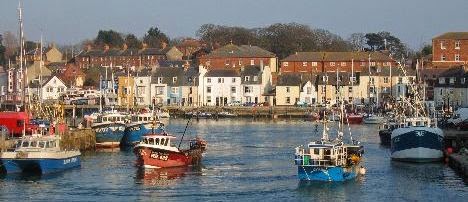
The harbour at Weymouth.

The blog will be a little quieter this week, because I'm off on holiday to the above.  I just hope it does not rain all the time!  Hi di ho!


Frome Museum, and "Quarry Faces" a History of the Stone Quarries in the Area.

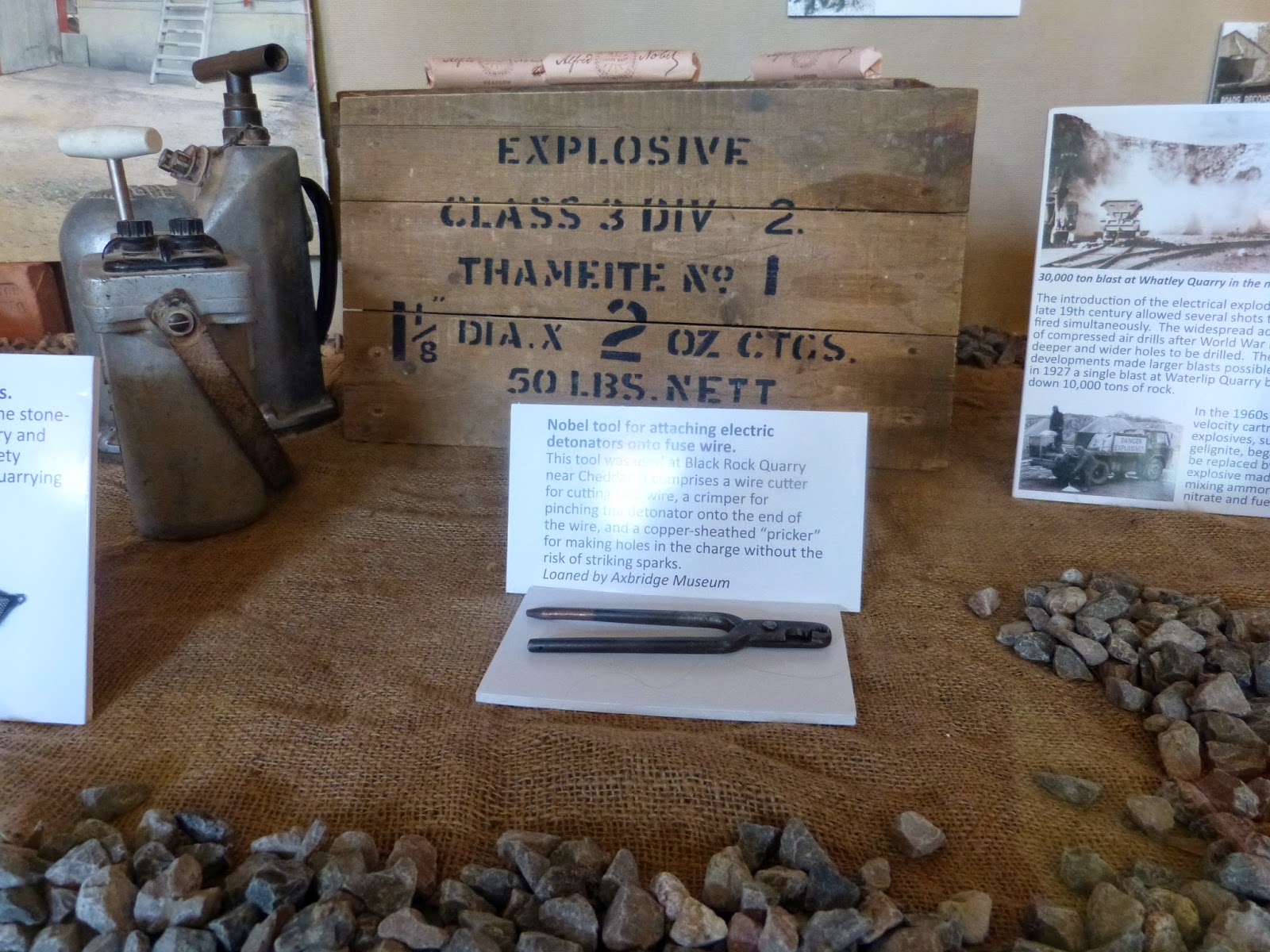
 Box of Explosives and a detonator.

This interesting little museum in Frome,, a hilly little town, with all the most interesting shops at the top of the hill of course,  lies in the cider making county of Somerset.  At the moment it is showing a special exhibition about the quarrying of stone in the local area.  The area is famous for its oolithic limestone, which has been quarried here since the 13th century.  The stone built nearby Wells Cathedral, and also some of the fine 18th century buildings in Bath.

The above photo shows a box that once held dynamite, an explosive discovered by Alfred Nobel, which made mining and quarrying a much easier process.  Stone could now be blasted out of the mines and quarries, instead of by the labour intensive method of hand cutting with huge saws.   To the left are two detonators, used for setting off the explosives.

The Nobel tool, lying in the foreground of the photo, was used to clamp the fuse wire onto the detonator.  These pincers were coated with ? (help me!) a metal which prevented sparking, and prematurely setting off an explosion.  I'm no chemist, so my knowledge here is a bit thin on the ground!

Sieves for the grading of road aggregate.

Aggregate is used for road construction, and after the stone was blasted out of the quarry, it was smashed into smaller pieces, and then graded in large hoppers into different sizes for various applications.

A view of the exhibition.

After our visit we found a local cafe for lunch, where we enjoyed tasty bacon butties,  cups of coffee and a glass of Somerset cider!   All my idea of a good day out.

The fossil remains of some of the large animals, that once roamed the local landscape.


Wednesday, 7 May 2014

May Bank Holiday Monday in the Market Place, Devizes.

The prancing horses enjoy their circular run.

I`ve been busy this week, so have got a little behind with my blog writing!  Also the time was "out of joint," because last Monday was a bank holiday, and then the following days felt in the wrong order.   I´m sure I´m not alone in feeling lost sometimes!   These photos were taken at the "Devizes Lions" Bank Holiday festival in the Market Place last Monday.  The sun shone for a change, and everyone had a good time.   

The prancing horses were kept busy all day, not only by children, but with older ladies and grannies, who were reliving the experiences of their youth.   Many years ago I took a ride on a similar roundabout, but was so ill, that I´ve never ventured near one again. 

Captive ducks wait to be caught.

I visited early, before it got too crowded, and saw these little ducks waiting to be captured by excited children.  The chap running the stall is holding the sticks with hooks on the end, which are used to "fish out" each duck.

Mr Punch and his poor wife and baby frighten the children.

Plants for sale.

The collectors' market in "The Shambles."

This old building called "The Shambles" was the Devizes Cheese Hall, and used in the 18th and 19th century as a market place.   One wall holds an old information board entitled, "Rules of the Cheese Market" which lists what can be done and what not in the market.  The building was recently renovated, and now regular collectors´ markets take place throughout the week.  The building was used in the filming of "Far from the Madding Crowd" way back in the 1970´s.